
Peptide Supplier Guide
How to Choose a Peptide Supplier for Skincare Product Development
Learn how B2B skincare buyers evaluate peptide supplier quality, documentation, formulation fit, MOQ, compliance safety, and OEM/ODM development support before moving into sampling or production.
For skincare brands, distributors, salons, and OEM/ODM buyers, choosing a peptide supplier is not only a raw-material decision. It also affects formulation stability, product positioning, compliance communication, sample efficiency, and long-term supply planning. In B2B skincare development, peptides are often used to support premium product concepts, but the commercial value of a peptide-based formula depends heavily on how well the supplier fits the full manufacturing workflow.
Many buyers focus first on the ingredient name itself. That is understandable, because peptides are widely associated with high-value skincare concepts. But experienced buyers know that ingredient sourcing is only one part of the decision. A suitable supplier should also support technical communication, documentation clarity, quality consistency, and realistic formulation application.
This guide explains what B2B buyers should evaluate when selecting a peptide supplier for skincare projects, especially when the end goal is private label, OEM, or ODM product development rather than ingredient trading alone.
Why Choosing the Right Peptide Supplier Matters
Peptides are usually positioned as functional cosmetic ingredients in serums, creams, ampoules, eye care products, and complete treatment-oriented skincare routines. In theory, adding a peptide sounds straightforward. In practice, a peptide-based product still needs to work within a full formulation system that includes texture, preservative strategy, pH range, packaging compatibility, and target market expectations.
If the supplier cannot provide clear ingredient information or practical formulation support, the brand may face delays during sampling or difficulty translating the ingredient into a market-ready skincare product. A peptide ingredient can look promising on paper but still perform poorly in a finished cosmetic product if the formula design, usage level, or product concept is not aligned.
For this reason, B2B buyers should evaluate a peptide supplier based on both ingredient quality and development usefulness. The best supplier relationship is one that helps move a concept from technical discussion to stable, commercially workable production.
What Is a Peptide Supplier in the B2B Skincare Context?
In the skincare industry, a peptide supplier may be a raw-material company, a formulation-support partner, or a manufacturer with peptide-based formula capabilities already integrated into OEM/ODM development. The exact role matters.
Some buyers are sourcing peptide ingredients directly for in-house R&D. Others are not trying to buy isolated raw materials at all. They are looking for a manufacturer that already understands how peptide concepts fit into finished products such as facial serums, creams, masks, or treatment-support routines.
This distinction is important because many B2B skincare buyers do not need a stand-alone ingredient trader. They need a development partner that can turn peptide-related product ideas into compliant cosmetic formulas with workable packaging, MOQ, and production planning.
Key Criteria for Evaluating a Peptide Supplier
1. Ingredient Documentation and Technical Clarity
A serious peptide supplier should be able to explain the ingredient identity, recommended application logic, basic specification details, storage considerations, and how the peptide is generally positioned in cosmetic use. Buyers do not need inflated marketing language. They need clear technical information that supports evaluation.
At the supplier-screening stage, useful questions include whether the ingredient has consistent documentation, whether the supplier can communicate clearly with the formulation team, and whether the technical data is practical enough for product development rather than only promotional use.
If the information is vague, inconsistent, or overly sales-driven, the buyer may struggle later during sampling, product positioning, or compliance review.
2. Formulation Compatibility in Real Skincare Products
A peptide ingredient is only valuable when it works in a formula that can actually be produced, filled, shipped, and sold.
That means buyers should ask whether the peptide concept is suitable for the intended product category. A serum may need a lighter texture and a clear absorption profile. A cream may need stronger texture balance. A facial routine may need the peptide concept to match other products in the same line without creating a confusing product story.
An experienced peptide supplier or peptide-capable manufacturer should be able to discuss the ingredient in relation to emulsion systems, texture goals, packaging formats, and routine logic. This is especially important for brands building anti-aging, firming, or premium-care positioning in cosmetic categories.
3. Compliance-Safe Communication
Peptides are often surrounded by exaggerated claims in the market. That creates risk for B2B buyers.
A reliable peptide supplier should understand that cosmetic communication must stay within compliance-safe wording. Product language should focus on appearance, skin feel, smoothness, hydration support, firmness-related positioning, or overall care experience where appropriate. It should not promise medical treatment, permanent correction, or guaranteed outcomes.
This matters not only for labels and websites, but also for how the product is discussed during development. If a supplier frames the ingredient with unrealistic claims, the brand may later need to rewrite positioning, packaging copy, and sales materials.

4. Quality Consistency and Batch Reliability
Consistency is critical in B2B manufacturing. Even when a buyer starts with a small MOQ project, repeat-order stability matters from the beginning.
When evaluating a peptide supplier, brands should look at whether the company appears structured in its quality communication, whether it can support stable sourcing over time, and whether it understands the expectations of export-oriented cosmetic projects. The buyer is not only screening for one successful sample. The buyer is screening for repeatable supply that can support scale if the product line performs well.
A peptide-based formula that works in sample stage but becomes difficult to repeat later creates avoidable business risk.
5. MOQ, Development Efficiency, and Commercial Fit
Not every peptide-based project needs to begin with a large launch.
For many B2B skincare buyers, especially new brands or channel buyers testing a market, the practical question is whether the development path can stay commercially manageable. Even if the peptide itself is attractive, the project should still make sense in terms of MOQ, packaging choice, formulation complexity, and launch timeline.
This is why many buyers prefer working with an OEM/ODM skincare manufacturer that can balance ingredient direction with finished-product execution. Instead of sourcing the peptide separately and coordinating multiple partners, the buyer may be able to move faster with one manufacturer that supports formula recommendation, packaging matching, and production planning together.

What Questions Should You Ask a Peptide Supplier?
A buyer does not need to ask everything at once, but the following questions usually help reveal whether the supplier is commercially and technically useful:
- What type of skincare products is this peptide concept most suitable for?
- Can the ingredient be positioned clearly within cosmetic communication?
- What supporting documentation is available for evaluation?
- How does the peptide fit into serum, cream, mask, or treatment-support product development?
- Is the supply path suitable for repeat orders if the product scales?
- Can the supplier support OEM/ODM development, or only raw-material sales?
These questions help move the discussion away from hype and toward practical product-development value.
When a Manufacturer May Be Better Than a Stand-Alone Peptide Supplier
For many B2B buyers, the real goal is not to purchase a peptide as an isolated ingredient. The goal is to launch a skincare product that sells well and can be reordered smoothly.
In that case, a peptide-capable skincare manufacturer may be more useful than a stand-alone supplier. A manufacturer can evaluate the peptide concept in relation to the full formula, packaging, target market, and production requirements. This reduces the number of coordination points and often improves decision speed.
It is especially useful for buyers who want to build private label or OEM/ODM lines around categories such as facial serum, anti-aging cream, eye care, masks, or coordinated treatment-support routines.
For broader supplier screening, you can also read How to Choose a Reliable Skincare Private Label Manufacturer. If your team is deciding between launch models before choosing ingredient direction, Custom Skincare vs Private Label is also relevant.
How CrownDiaBio Supports Peptide-Based Skincare Development
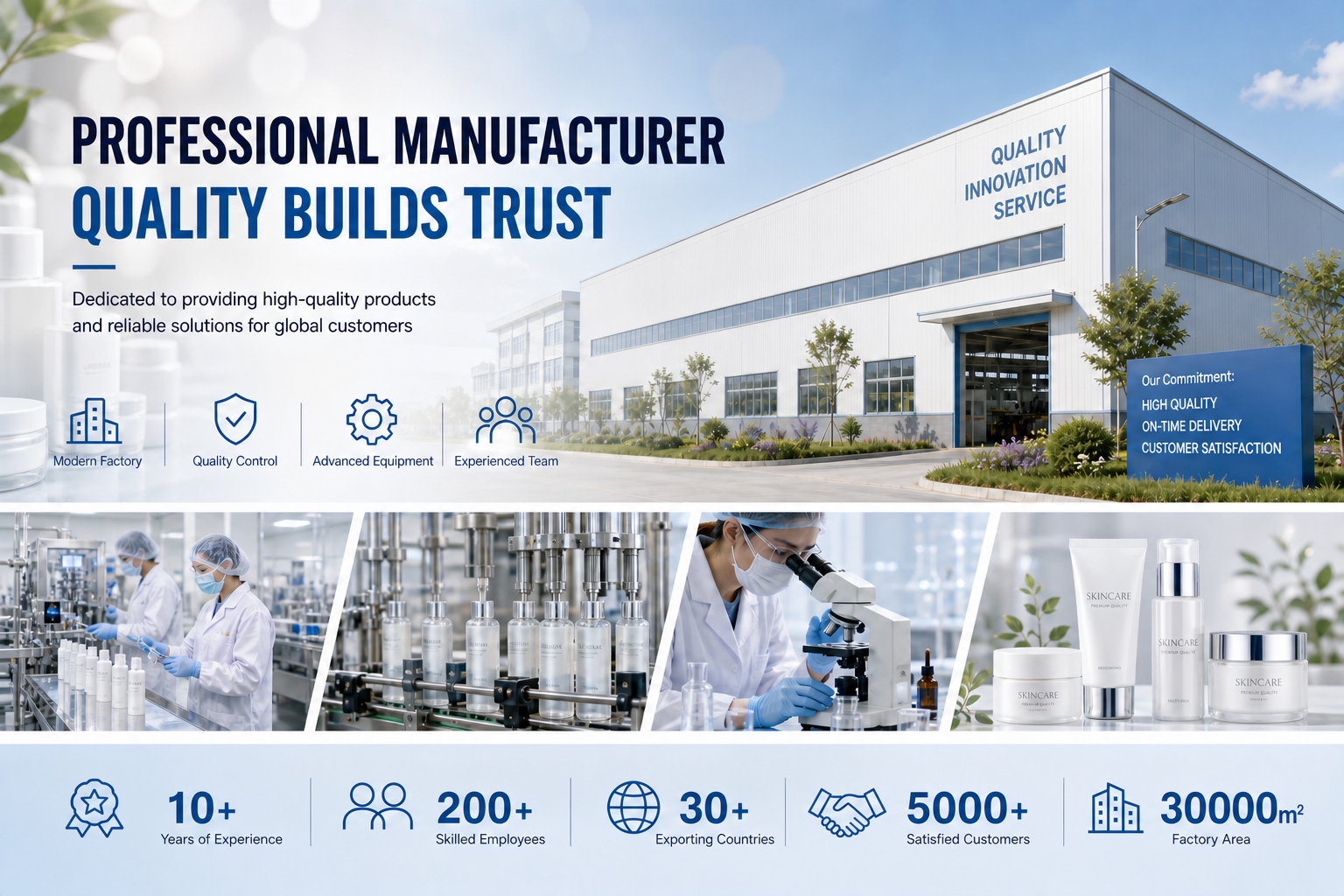
CrownDiaBio is a Guangzhou-based skincare manufacturer with more than 20 years of experience in OEM, ODM, private label, and custom formulation projects. For B2B customers exploring peptide-based skincare concepts, the practical value is not only ingredient discussion but also how that concept is translated into a finished cosmetic product.
The company supports product development across facial care and body care categories, with around 300+ formula options, MOQ from 100 units for selected projects, and monthly capacity up to 660,000 units. CrownDiaBio also supports GMP, ISO 22716, and SGS-related documentation, which helps buyers evaluate manufacturing readiness with more confidence.
For brands that want to build peptide-positioned serums, creams, facial kits, or complementary skincare routines, CrownDiaBio can help assess category fit, texture direction, packaging coordination, and project feasibility within an OEM/ODM workflow.
Final Thoughts
Choosing a peptide supplier is not about chasing the most impressive ingredient story. It is about finding a partner that supports technical clarity, formulation practicality, compliance-safe communication, and long-term supply reliability.
For many B2B skincare buyers, the best outcome comes from working with a partner that understands both the peptide concept and the realities of finished-product development. That makes it easier to move from ingredient interest to a launch-ready skincare formula with clearer commercial direction.
If you are planning a peptide-based serum, cream, eye care product, or private label skincare line, CrownDiaBio can help you evaluate suitable OEM/ODM development options and discuss how peptide concepts fit your target market.
Contact CrownDiaBio to discuss your peptide-based skincare project and request formula recommendations or samples for your OEM/ODM line.